

“Best in the nation” is a fraught term, inviting all sorts of biases, depending on what you’re measuring, how you’re measuring, and who’s doing the measuring (and from where).
When someone is declared the “best prospect in the nation,” that tends to ring true. College basketball generates more than $1 billion a year. You’d best believe that the processes and resources are in place to evaluate the talent that keeps the big-money machine cranking.
But high-school basketball? Not so much, not yet, the exception being that college recruits of course come out of high school. There are some differences between what a player is today and how a player projects to another level. However, a lot of the physical and mental qualities that bode well for the future also bode well for the present. Some would say that performance and success, on the team and individual level, aren’t always good predictors of longer-term excellence but, believe me, coaches and college scouts pay attention to them, too.
I just spent a whole season watching Tyran Stokes play for Rainier Beach High School. He was declared the consensus best senior prospect in the nation before he arrived in Seattle. All that’s happened since has computed for me, given the role I had, as outlined in Part I, in shaping the coverage and actual execution of scouting college prospects.
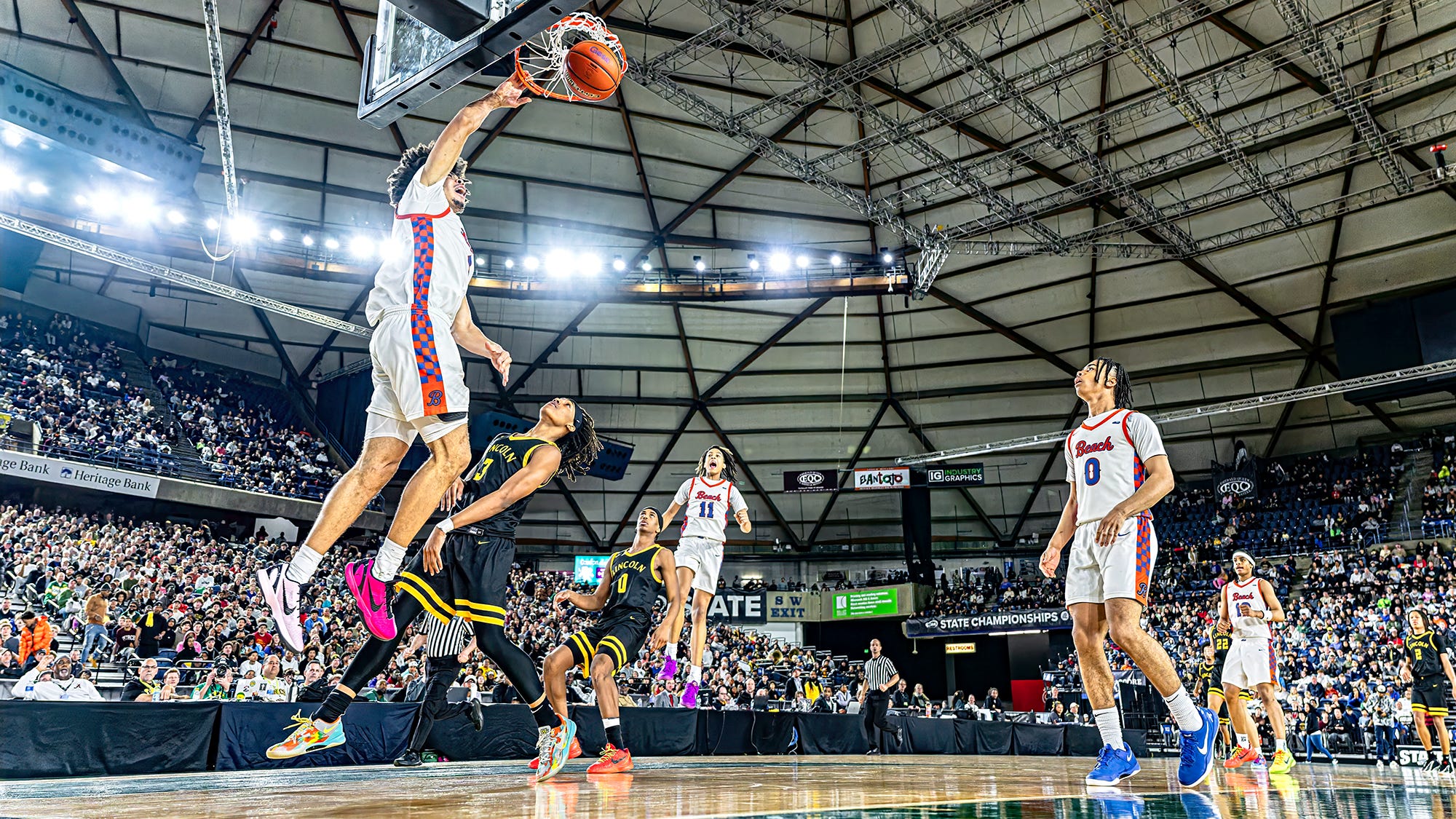
Stokes doesn’t just have every physical attribute and skill you could want and imagine, he has some you couldn’t imagine that you could want. That is, preternaturally advanced basketball IQ, as well as outlier talent, for catching a basketball thrown from any angle and speed, and attracting contact from defenders, anywhere on the court. He also performed spectacularly, averaging 30.8 points, 10.6 rebounds, 5.2 assists, 3.4 steals, and 1.6 blocks per game, setting the school single-game scoring record with 63 points, and executing dunks of every degree-of-difficulty quotient possible.
Yet one major national player of the year award already has been announced – the Naismith by the Atlanta Tip-Off Club – and it did not go to Stokes. It went to a player, Jordan Smith Jr., who is ranked a spot or two below Stokes as a prospect, whose statistics weren’t nearly as sterling, and whose team, St. Paul VI Catholic of Chantilly, Va., suffered one more loss than did Stokes’ 29-1 Rainier Beach Vikings.
So how does that happen (he asks, as others ask how Rainier Beach can be disinvited from a “national championship” tournament)? It could be as simple as Atlanta being on the East Coast and Chantilly being 10 hours north, on the same coast. East Coast bias is a thing, regional bias is a thing, proximity bias is a thing. During decades of visiting the East Coast for work, and attending grad school out there, I’ve met dozens upon dozens who believe that the West is so spread out, it’s inhabitants must be soft. The density of the East translates, to those who live there, to density of talent, resources, and circumstances producing the dog-eat-dog grind that chews up pretenders and spits out champions.
Except, after years of traveling the country in search of team and individual talent, I can honestly say that I’ve seen some gawdawful teams in the East Coast hot beds that had reputations for being otherwise. I also can say that one of the major accomplishments of ESPN HoopGurlz was lifting the veil on West Coast talent. We were celebrated for it, by coaches from every region in the country. And it wasn’t as if we focused on our own backyard, if there was such a thing (our staff had great geographic distribution), we were just the first to not ignore it.
To overcome the very human instinct to go with what you know, you have to leave your little box, and see the rest of the world. That’s not easy, especially on a search for team excellence. The travel can be financially prohibitive (we had a gigantic travel budget when we were at ESPN, because we were there during the company’s hey day) and it’s a grind. It’s much easier to comparison shop recruits because, with all the meat-market showcases and camps, the candidates literally come to you. Grab a hotdog, a seat cushion, and a Diet Dr. Pepper, and you’re good to go.
In making a case for Rainier Beach’s national relevancy, I’ve put eyes on other teams, albeit on video, which is the next best thing to being there. The best teams usually have the best players, so I’ve watched Jordan Smith Jr. play with St. Paul VI, which, in Part I, I determined to be the No. 1 seed in my mythical “national championship” field. The second or third best recruit in the 2026 class, Smith of course is a fine player. He’s smart, explosive, makes his teammates better, is well-built and, I’d judge, better than Stokes in using his body to create space for his shots and is the better defender.
Who do I think was a better player this season? All things being equal – and they weren’t, Stokes being 6 feet 8 and Smith 6-3 – I’d take the player who scored 63 points in a game and had a triple-double in a state tournament game, who made more spectacular plays, and whose team played more of a “national” schedule. And if I didn’t forget the legacy of basketball distinction in Seattle and assume Rainier Beach didn’t play a bunch of nobodies … who do you think?
People can sew underestimation onto a team, the same way they can a player. That’s why I’ve shifted the focus, for this piece, on national relevancy to Stokes – to make the same point about Rainier Beach. I’m not sure the outside world saw how the Vikings absolutely flattened their state tournament opposition. I think resentment and anti-frontrunner bias led some people to declare the Stokes-led Vikings as inferior to the previous year’s version. And I think a lot of people believe that Stokes was “stopped” in the 3A state tournament.
If you can say that clubbing someone into submission was “stopping” them in a contest, then I suppose Stokes was “stopped,” in that sense. Every coach who opposed Rainier Beach after the holiday break is guilty of reckless endangerment because they instructed their team to get physical in their defense of Stokes. That is, they charged a bunch of teenaged boys, who’ve no better grown into their bodies than grown into their minds, with meting out violence and determining for their young selves the optimal measure of such punishment.
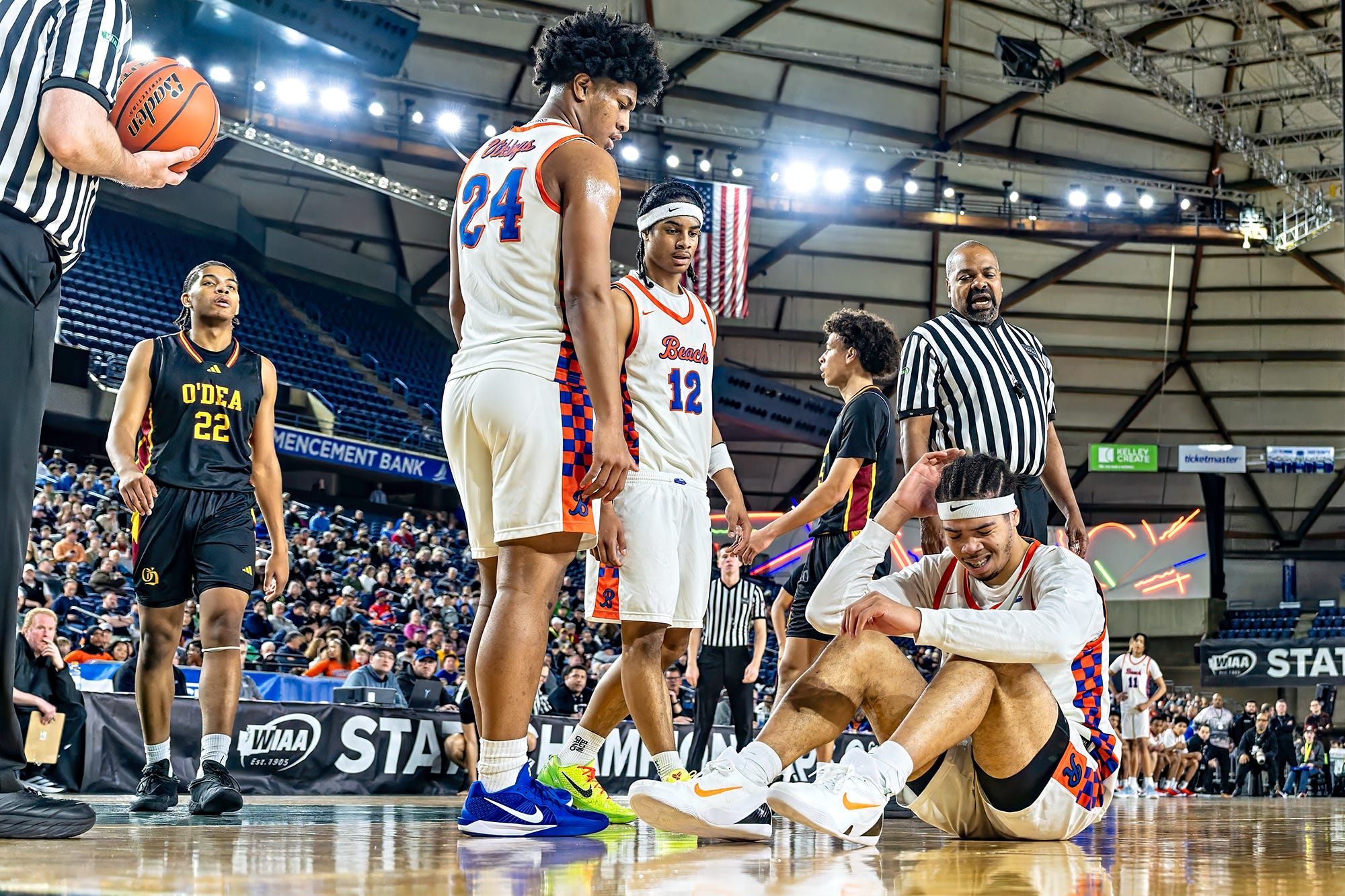
By the time Rainier Beach played through the district playoffs, Stokes was experiencing back spasms, had welts on his body, and cuts in his lips for every elbow he took into his braced teeth. The brutality worsened in the Tacoma Dome – schools and coaching staffs justifying assault as a means of winning a trophy. When yang-talking Davion Shareef-Dulaneay leaped onto Stokes’ back in the championship game, the Viking star asked for a flagrant foul. The nearest referee reasoned that Shareef-Dulaneay simply bit on a very good Stokes head fake. But I was right there; the Lincoln of Tacoma sophomore did not try to avoid Stokes, he rather added force to the collision.
So when The Throne announced, “Rainier Beach will no longer compete … this year due to injuries,” it had to have been referring to Stokes as among the walking wounded. But I know this: The same “injured” Vikings, including Stokes, who gritted through three tournament games for a state championship certainly would have done the same with a “national championship” on the line.
And in all the games I watched across the country of very good teams playing other very good teams, including those involving Rainier Beach, the players went hard, but they didn’t cross the line as so many teams did against the Vikings inside the state of Washington. I’m confident in saying that the physical play Rainier Beach saw during the last couple months would not have been a factor in a national tournament. I’m equally confident in saying that the Vikings’ national aspirations were sabotaged, in no small part, by the small-mindedness of their in-state opposition.
PART III: After this detour to clarify the discourse on national perception and relevancy, I will continue the discussion of the mythical “national championship field,” and where and how Rainier Beach fits in.